Foundation cracks in Girard homes fall into three buckets, and each gets a different fix. Vertical or diagonal cracks in poured concrete walls are usually shrinkage cracks from the original cure, visible inside the first five years. Horizontal cracks halfway up a poured or block wall are serious, that is the clay pushing the wall inward and the fix is either exterior waterproofing or interior bracing, not just injection. Stair-step cracks on concrete-block walls are mortar-joint failures from the same clay pressure. On the inspection we tell you straight which bucket your crack falls in.
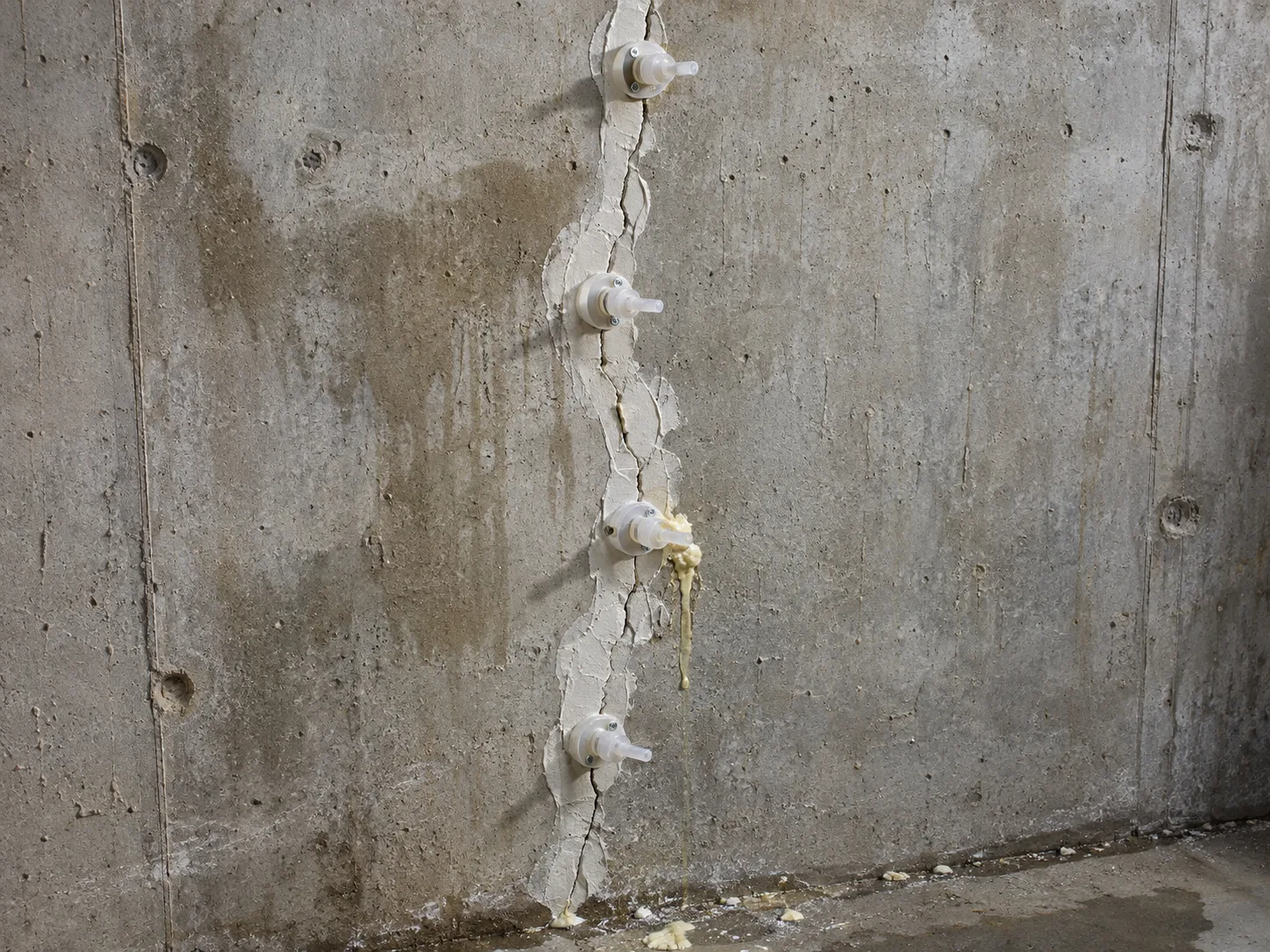
Polyurethane injection is the standard fix for a non-structural leaky vertical crack in a poured wall. We port-pack the crack, inject hydrophobic polyurethane under low pressure from the bottom port up, and watch it foam out of the next port up before moving on. Polyurethane is the right pick for an actively wet crack because it reacts with water to expand and fill voids the resin would miss. Cures to a flexible seal that handles the Mahoning Valley freeze-thaw cycle without cracking back open. Single-crack injections take 2 to 3 hours and the wall is sealed before we leave.
Epoxy injection is the structural repair, used on dry cracks where the wall needs its original strength restored rather than just a seal against water. Two-part epoxy is injected under slightly higher pressure and cures to a bond stronger than the surrounding concrete. Common on newer builds in the Ohltown corridor where a shrinkage crack has opened up but the wall is otherwise sound. Epoxy is the wrong call on an actively wet crack because the resin cannot bond to a wet substrate and water will just find a new path.
Horizontal cracks in a block wall are the serious call. That is Mahoning Valley clay pressure pushing the wall inward, usually along the horizontal mortar joint 4 feet up where the backfill pressure peaks. Injection does not fix the pressure, it just hides the symptom for a season. We honest-recommend carbon fiber straps epoxy-set to the wall or steel I-beam bracing instead, usually $350 to $800 per strap, and we tell you whether exterior excavation needs to come in the next 3 to 5 years. Never inject a horizontal bowing crack and call the job done, that is how homeowners get burned.
What we handle
Polyurethane Crack Injection
Low-pressure hydrophobic polyurethane injection for actively wet vertical cracks in poured concrete walls. Flexes with freeze-thaw cycles and cures around residual moisture.
Epoxy Crack Injection
Two-part structural epoxy injection for dry non-leaking cracks that need the original wall strength restored. Right call on shrinkage cracks in newer poured walls.
Mortar Joint Repointing on Block Walls
Grind out failed mortar joints on concrete-block walls and repack with fresh mortar. The standard fix for stair-step cracks on older Girard block foundations.
Carbon Fiber Wall Reinforcement
Carbon fiber straps epoxy-set to the interior of a bowing block wall to stop further inward movement. Used on walls bowing less than 2 inches.
Rod Hole and Form Tie Repair
Seal the leaking rod-hole or form-tie points in poured concrete walls, common on newer builds where the tie-hole plugs were never properly filled.
How the job goes
1. Phone Intake
You call. We ask wall type, where the crack is, horizontal or vertical, and whether it is wet. You get a likely cause and a price band for a single-crack injection within 10 minutes. Multi-crack and bowing-wall jobs need an on-site inspection.
2. On-Site Inspection
Crew lead measures the crack length, checks for wall deflection with a 4-foot level, and marks whether the crack is actively seeping. For stair-step cracks on block walls we also check the exterior grading and downspouts. Inspection runs 30 to 45 minutes.
3. Written Quote and Repair
Price handed to you in writing. Most single-crack injections get done on the same visit if we have a slot open. We port-pack the crack, inject from the bottom port up, cap and clean the wall. Standard job runs 2 to 3 hours per crack.
4. Cure and Warranty
Polyurethane cures to a flexible seal in 10 to 15 minutes, epoxy cures structurally in 24 hours. Written warranty handed to you on the single-crack jobs covering the sealed crack against re-leak.
What's included
- On-site crack inspection and wall deflection check
- Written flat-rate quote before any injection starts
- Port-pack every 6 to 10 inches along the crack
- Polyurethane or epoxy injection appropriate to crack condition
- Low-pressure injection from the bottom port up
- Port removal and surface skim-coat where visible
- Photos of each crack before and after
- Written workmanship warranty covering the sealed crack against re-leak
What it costs
Single-crack polyurethane injection in Girard runs $350 to $1,200. Multi-crack jobs run $900 to $2,800. Carbon fiber bracing runs $350 to $800 per strap. Mortar joint repointing on block walls runs $800 to $2,500.
| Job | Typical price | Notes |
|---|---|---|
| Polyurethane Crack Injection, Single Crack | $350 to $1,200 | Standard vertical wet crack on a poured wall up to 8 feet long. Higher end for longer or wider cracks and for multiple attempts on previously-repaired cracks. |
| Epoxy Crack Injection, Single Crack | $450 to $1,400 | Structural repair on dry cracks. Slightly higher cost than polyurethane because of the longer cure and higher material cost. |
| Mortar Joint Repointing on Block Wall | $800 to $2,500 | Priced by linear feet of joint needing repointing. The right fix for stair-step cracks in older Girard concrete-block foundations. |
| Carbon Fiber Wall Reinforcement | $350 to $800 per strap | Spaced every 4 feet on a bowing block wall. Used only on walls bowing less than 2 inches. Over that threshold we recommend exterior excavation. |
| Free On-Site Crack Inspection and Quote | Free | Full crack measurement, wall deflection check, exterior grading walk. No obligation. |
Ranges are typical for Foundation Crack Repair jobs in Girard and confirmed with an exact written quote before any work starts.